


azimey.xorlali.68y [at] st.kyoto-u.ac.jp
Xorlali Azimey
Master's Student
Wildlife Research Center (Kyoto)
Research
My research focuses on the genetic basis of behavior, specifically tameness and aggression in the grasscutter (Thryonomys swinderianus), a rodent species native to West and Central Africa that serves as an important source of protein. Our study combines genetic data, including genotypes and polymorphisms, with behavioral assessments of tameness to identify genetic variants associated with calmer temperament. These insights will help guide the selection and breeding of tamer individuals to improve grasscutter performance under domestication.
In many regions in Ghana, grasscutters are still primarily hunted from the wild, a practice that contributes to forest fires, ecosystem disturbances, and zoonotic disease risks due to the species’ popularity as a delicacy. Although domestication efforts have increased over the past decade, the species’ aggressive behavior in captivity remains a major challenge, often resulting in injuries, deaths, and reduced production efficiency.
Our research aims to address these issues by identifying and selecting individuals that exhibit genetic markers linked to tameness. The ultimate goal is to develop a breeding and selection framework that enhances productivity and profitability for farmers while promoting environmental sustainability. Importantly, this approach relies entirely on natural genetic variation rather than genetic modification.
Background
October 2024 - present: Postgraduate Student, Graduate School of Biological Sciences, Wildlife Research Center, Kyoto University, Japan.
- || Genetic Research || Primate and Avian Field Observation || Seminar Presentations || Science Communication
August 2023 - April 2024: Youth Leaders Fellowship (YoLe Fellow), United Nations Population Fund - UNFPA Ghana, Accra, Ghana
- || Programs Planning & Implementation || Public Speaking || Policy & Research,|| SRHR
November 2022 - August 2023: Research/Teaching Assistant, College of Basic and Applied Science, Department of Animal Science, University of Ghana.
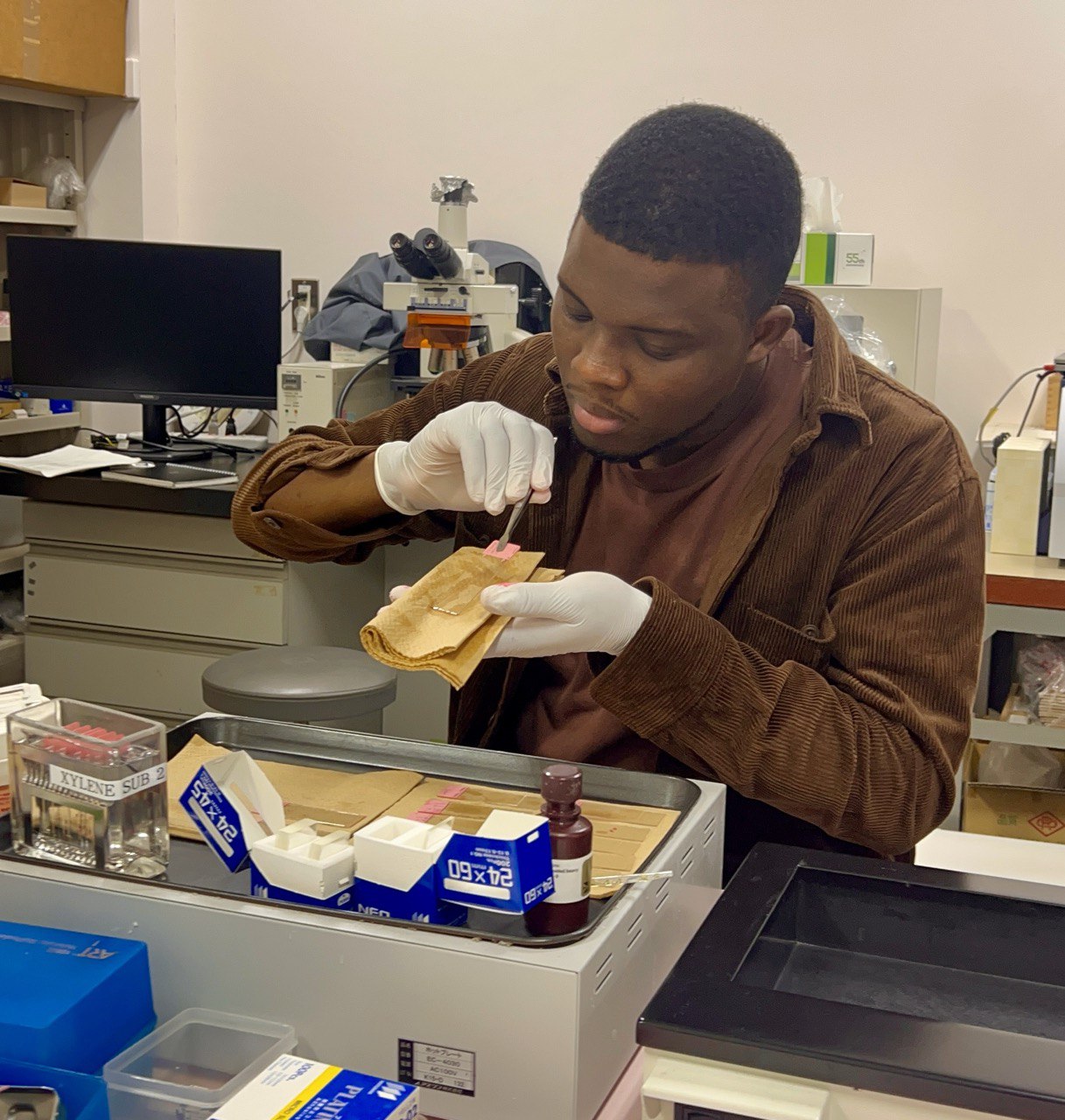
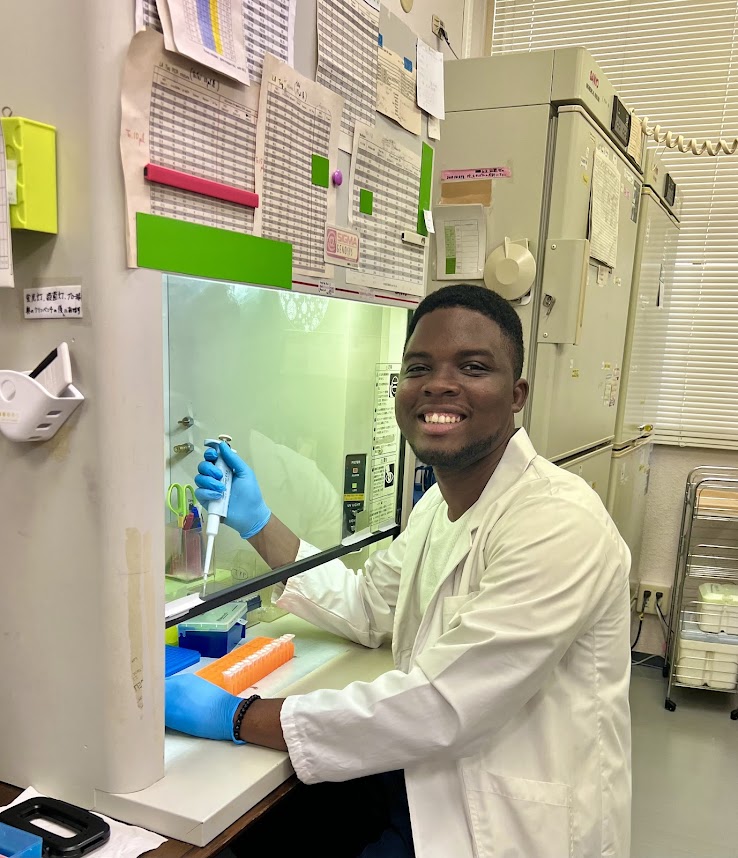
- || Lab Experimentation – ELISA for Newcastle Disease in Poultry || Undergraduate Student Tutoring || Field Data Collection (blood samples, body weight) & Data Analysis
August 2018 - Oct 2022: Bachelor of Science in Agriculture (Animal Science), College of Basic and Applied Science, Department of Animal Science, University of Ghana.
- || Dissertation: Applications of Genomics to improve disease resilience in farm animals: A Review || General Agriculture
Current Projects
We are currently investigating three candidate genes in the grasscutter that have been linked to behavioral variation in other species: the androgen receptor gene, the oxytocin receptor gene, and the vasopressin receptor gene. These genes possess different types of polymorphisms in them that have been associated with traits such as aggression, social bonding, and other behavioral phenotypes across mammals.
In grasscutters, our study relates genetic data from these loci to behavioral measurements collected from captive-bred populations to evaluate how the specific variants influence temperament (Tameness). By quantifying both genotype and behavior, we hope to estimate not only whether these polymorphisms affect tameness but also the magnitude of their effects on this key domestication trait.
Selected Publications
Research Presentation
Poster presentations
Xorlali Azimey, Yu Sato, Bhim B. Biswa, Kazumichi Fujiwara, Tsuyoshi Koide, Christopher Adenyo, Boniface B. Kayang, Miho Inoue-Murayama. Genetic insights into behavior: Exploring polymorphisms in candidate genes for enhanced domestication of grasscutters (Thryonomys swinderianus) in Ghana. The 62nd Annual Conference of the Japan Society for African Studies (JAAS) (P10). Kyoto University, Kyoto, Japan. May 17-18, 2025.
Xorlali Azimey, Yu Sato, Bhim B. Biswa, Kazumichi Fujiwara, Tsuyoshi Koide, Christopher Adenyo, Boniface B. Kayang, Miho Inoue-Murayama. Genetic insights into behavior: Exploring polymorphisms in candidate genes for enhanced domestication of grasscutters (Thryonomys swinderianus) in Ghana. The 20th International Symposium on Primatology and Wildlife Science (P15). Kyoto University, Kyoto, Japan. November 17-18, 2025.
Xorlali Azimey, Yu Sato, Bhim B. Biswa, Kazumichi Fujiwara, Tsuyoshi Koide, Christopher Adenyo, Boniface B. Kayang, Miho Inoue-Murayama. Androgen receptor polymorphisms and behavioral variation in grasscutters (Thryonomys swinderianus): Implications for domestication: The 34th Annual Meeting of Japanese Society for DNA Polymorphism Research (P08). University of Tokyo, Tokyo, Japan. November 20-21, 2025.
Xorlali Azimey, Yu Sato, Bhim B. Biswa, Kazumichi Fujiwara, Tsuyoshi Koide, Christopher Adenyo, Boniface B. Kayang, Miho Inoue-Murayama. Genetic insights into behavior: Exploring polymorphisms in candidate genes for enhanced domestication of grasscutters (Thryonomys swinderianus) in Ghana. The Autumn Research Exchange Meeting by Biological Sciences (P40). Kyoto University, Kyoto, Japan. October 4, 2025. (Outstanding Poster Award)
Oral presentations
Xorlali Azimey, Polymorphisms in Oxytocin and Vasopressin Receptor Genes and Their Association with Tameness in Grasscutters (Thryonomys swinderianus). Wildlife Research Center Seminar, Kyoto University. Kyoto University, Kyoto, Japan. March 17, 2026.
Xorlali Azimey, Genetic Domestication of Grasscutters in Ghana. Beyond 2050: Social Implementation Dojo, Kyoto University, Kyoto, Japan. July 30, 2025.
Xorlali Azimey, Genetic Polymorphisms of Selected Candidate Genes Influencing Behavior in Grasscutters. Wildlife Research Center Seminar, Kyoto University. Kyoto University, Kyoto, Japan. July 22, 2025
Xorlali Azimey, Genetic Polymorphisms of Selected Candidate Genes Influencing Behaviour in Grasscutters (Proposal Presentation). Wildlife Research Center, Kyoto University Seminar. Kyoto University, Kyoto, Japan. December 24, 2024.
Press
Research Spotlight: Xorlali Azimey (master's student, WRC), Article by Casey Mack
https://cicasp.ehub.kyoto-u.ac.jp/news/research/research-spotlight-xorlali-azimey-masters-student-wrc
Ghana Grasscutter project (Enhancing Livelihoods in Ghana through Improvement in Native Livestock Production)
https://grasscutter.sakuraweb.com/
Contact
Graduate School of Science
Wildlife Research Center, Kyoto University
2-24 Tanaka-Sekiden-cho, Sakyo, Kyoto, 606-8203, Japan, Kyoto University
azimeyxorlali [at] gmail [dot] com / azimey [dot] xorlali [dot] 68y [at] st [dot] kyoto-u [dot] ac [dot] jp
Gallery