



The PrimateCast

Catch interviews from the world of primatology, wildlife science and beyond with The PrimateCast. Available here or on iTunes. Subscribe to our rss feed, add us on iTunes and follow us on social media at Facebook and Twitter @ThePrimateCast. View all Podcasts


Topics
- Announcements (55)
- Podcasts (92)
- Publications (28)
- Research (7)
Recent News


February 19th 2026
Monthly Archive
- March 2026 (2)
- February 2026 (1)
- October 2025 (1)
- November 2024 (2)
- March 2024 (1)
- February 2024 (1)
Follow Us


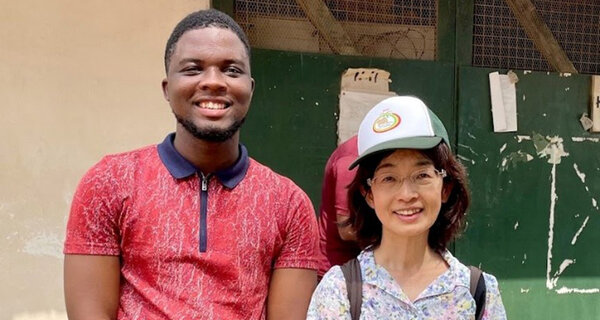
Research Spotlight: Xorlali Azimey (master's student, WRC)
Article by Casey Mack
Xorlali’s Journey into Research:
Under the cross-campus umbrella of the Department of Primatology and Wildlife Research, graduate students are actively involved in numerous international collaborative research projects. One such project is the Ghana Grasscutter Project, managed by Dr. Miho Inoue-Murayama of the Wildlife Research Center (WRC) at Kyoto University. We sat down with a master’s student involved in this project, Xorlali Azimey, to learn a bit about his time at WRC and the journey that brought him here.

Xorlali shared that his interest in biology research first took root while serving as national service personnel—a teaching and laboratory assistant—in the molecular genetics lab at the University of Ghana. Majoring in Animal Science, he had not formally trained in laboratory biology, but his curiosity drew him to gain hands-on experience. During his second year as an undergraduate student, he joined an internship under Professor Boniface Kayang, working on poultry genetics. In 2021, Prof. Kayang, who had collaborated with Murayama-sensei for over a decade since doing his post-doctorate appointment at WRC with her, introduced Xorlali to the grasscutter project in Japan. Though grasscutters were familiar to him as a common food in Ghana, he was fascinated to learn that scientists were studying them, and he was eager to join.
Growing up in the Volta region of southern Ghana, Xorlali recalls seeing farmers trapping grasscutters near the forests, and even trying (though unsuccessfully) to catch them with his father as a child. While relatively unknown outside sub-Saharan Africa, grasscutters are prized locally, fetching a high price at bushmeat restaurants due to their smaller size and difficulty of hunting them.

Crossing Borders, Strengthening Ties
The chance to study in Japan while contributing to research tied closely to his home country was especially meaningful for Xorlali. Awarded the prestigious MEXT Scholarship, Xorlali began his time in Japan with intensive Japanese language training courses before enrolling at Kyoto University to join Dr. Murayama's research group.
This fall, Prof. Kayang returned to Kyoto as a visiting professor, allowing Xorlali to meet with both his home-country mentor and his current supervisor together. Having this bridge between Ghana and Japan has been invaluable to him. Conducting research in a foreign country can be daunting, but Xorlali advises prospective students to be “open to learning, overcoming biases, and evolving current knowledge.” He described his experience as “interesting and insightful,” full of growth and adaptation. He is grateful to Murayama-sensei and his senpais for their support and helping him assimilate to the culture and environment in Japan.

Grasscutter Genes
The Ghana Grasscutter Project has many different aspects. Xorlali assists Murayama-sensei with identifying genes that could be linked to aggressiveness, a trait that complicates captivity, to improve domestication and production of grasscutters. Improving domestication processes would help decrease the hunting of wild grasscutters, in which hunters often uses poison or fire to flush the rodents out of hiding in vegetation—with detrimental effects on other wildlife. Xorlali explains that this type of research has been transformative, shifting his perspective from viewing wildlife primarily for human use to considering what role he can play to protect the environment.
Looking Ahead: Science for Social Good
Reflecting on his graduate experience, Xorlali highlights not just academic skills but also personal growth. He has improved his time management and goal-setting abilities while learning the importance of work-life balance—something made easier in the bustling city of Kyoto.
Xorlali plans to make the most of his opportunities at WRC to prepare for a career as a scientist. He is especially interested in projects at the intersection of science and social impact–a commitment strengthened by his experience on the Ghana Grasscutter Project, which includes social outreach initiatives and tackling food security. Food insecurity and malnutrition are crises close to Xorlali’s heart, and remain pressing issues in Ghana, particularly in the northern region where harsh climates hinder agriculture. For Xorlali, tackling such challenges is not only a research interest but also a deeply personal mission. While his specific role on the project focuses on genetics, he values the chance to contribute to and support the broader mission of the project: linking science with conservation and community well-being.
