



The PrimateCast

Catch interviews from the world of primatology, wildlife science and beyond with The PrimateCast. Available here or on iTunes. Subscribe to our rss feed, add us on iTunes and follow us on social media at Facebook and Twitter @ThePrimateCast. View all Podcasts


Topics
- Announcements (55)
- Podcasts (92)
- Publications (28)
- Research (7)
Recent News


October 7th 2025
Monthly Archive
- March 2026 (2)
- February 2026 (1)
- October 2025 (1)
- November 2024 (2)
- March 2024 (1)
- February 2024 (1)
Follow Us


Research Spotlight: Amos Chua (master's student, WRC)
Article by Brenda de Groot
Banner image: Wildlife Research Center’s Koshima island field course (Photo by Aru Toyoda)
At Kyoto University’s Wildlife Research Center (WRC), graduate students conduct field-based research on some of the world’s most socially complex and ecologically important animals. Today, I’m interviewing Amos Chua, a WRC master’s student, who shares his journey from conservation work in Singapore to primatology in Japan, and introduces his current research on understudied communities of long-tailed macaques in Vietnam. As we sit in the chilly meeting room, being treated to Kyoto’s February cold, we talk about what drives his work, his fieldwork experiences, and why studying lesser-known primate populations matters.
Before starting your master’s study at Kyoto University, you already had quite an extensive research background. Can you tell me a bit about what you did before coming here?
Before coming to Japan, I worked for about two years in Singapore, where I’m from. I completed my undergraduate degree at Nanyang Technological University, in the Faculty of Biological Sciences. That was where I was first introduced to conservation work and primatology. During my undergraduate years, I interned with the Jane Goodall Institute Singapore, where I helped with ecological and behavioral surveys of long-tailed macaques and Raffles’ banded langurs. That experience really sparked my interest in primate research and conservation.
After graduating, I worked for about nine months at Singapore’s National Parks Board, which is a government agency responsible for managing national parks and nature reserves. That job gave me a very different perspective on conservation: what it looks like from a governmental standpoint, and what kinds of practical challenges conservation agencies face day-to-day.
After that, I went back to the Jane Goodall Institute Singapore, this time as a program manager. I worked there for about a year. I was mostly involved in managing education programs. I developed materials and taught secondary school students about conservation, wildlife, and primates in Singapore. I also attended meetings and conferences and interacted with different people and organizations working on conservation and wildlife issues. So, before coming to Japan, I had seen conservation from a few different angles.

Jane Goodall Institute Singapore Internship, fecal sample collection (Photo by Glendon Kee)
So why did you decide to pursue a Master’s degree at Kyoto University’s Wildlife Research Center?
When I was an undergraduate, I already knew that I wanted to pursue primatology long-term. And I also knew that if I wanted to continue in this field—at least in Singapore—I would need a postgraduate degree. So, from quite early on, I knew that I would probably need to do a master’s and then a PhD study.
One important factor for me was funding. I didn’t want to rely on my parents financially for my studies, especially overseas, because the costs are quite high. So I knew I had to look for a scholarship. After I graduated, while I was working, I spent a lot of time looking into different scholarships and programs in different countries. Kyoto University came up because of the MEXT scholarship and because the primatology program here is very well-renowned. That combination made it very attractive. I applied for the MEXT scholarship once and didn’t get it the first time, so I reapplied the following year. Fortunately, I was successful the second time!
Before that, I also completed a short virtual internship at Kyoto University. It was only about a week long, but it gave a good overview of the program—what kinds of courses are taught, who the professors are, and what student life is like in Japan. I also spoke with some professors and students afterward to clarify some questions. After that experience, I felt quite sure that this was where I wanted to do my research, even before I knew whether I had the scholarship.

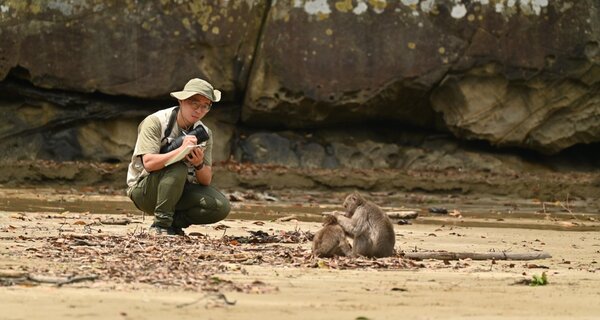
Master's research, observing macaques (Photo by Kellie Oh)
That must have been quite exciting then, when you got the scholarship! So, what is your current research project about?
I’m currently studying a subspecies of long-tailed macaques that lives on an island in Vietnam. Very little research has been done on this population. The broader research plan looks at their ecology, behavior, population structure, and genetics.
For my master’s thesis, I’m focusing more specifically on their social structure and social characteristics—things like dominance relationships and social network—and how these factors relate to interactions between macaques and humans. There is a human–macaque interaction component in my research, because this is an important issue in many parts of Southeast Asia.
What’s one behavior of long-tailed macaques that you think people would find fascinating?
That’s a hard question because there are a lot of interesting behaviors. But if I think about the group that I study, one thing that really stands out to me is how much time adult males spend with infants and juveniles. Normally, people expect infant care to be mostly done by adult females. But in my study group, adult males—especially the alpha male—are very involved. Almost every day, you see infants and juveniles spending time close to him. They play around him, sit near him, sometimes even cuddle around him. Other group members will also interact with the infants there. Because of this, adult females seem to have more time to forage, feed, or socialize. I found this really interesting, because it challenges some common assumptions about care roles in primate groups.
Was there a moment during your research when you felt, “yes, this is why I’m doing this”?
I don’t think there was one single moment. For me, it’s seeing and studying the macaques. Every day when I go to the field and see the monkeys, it reminds me why I’m here. Even when I’m very tired—and fieldwork is tiring!—observing them makes me happy. It’s a constant reminder of why I chose this path in the first place.
What do you hope to accomplish with your research—and I know you are at the start of your academic career, so let’s say at least for your current projects?
My main goal is to contribute information about lesser-known populations of long-tailed macaques. The species is very widely distributed, but many subspecies and local populations are still poorly studied. We know very little about their behavior or ecology. Many of these populations are isolated and endangered. If one of these populations disappears before it has been studied, then we lose not only the animals, but also all the information about them. There would be no historical record of how they lived or behaved. So even if the research is limited in scope or duration, having some documented information is still very important for future researchers and conservationists.
Last question: Do you have any advice for anyone who wants to become a primatologist?
From my own experience, I would say: know what you want, and know what your passion is. Once you figure that out, you should go for it and find ways to get yourself where you want to be. Fieldwork and desk work are both very demanding, and there will be difficult moments. During those times, it really helps to remind yourself of your goals and why you started. That’s what gets you through the hard parts, and what eventually gets you there.

Jane Goodall Institute Singapore primate talk (Photo by Shane Lee)