

The PrimateCast

Catch interviews from the world of primatology, wildlife science and beyond with The PrimateCast. Available here or on iTunes. Subscribe to our rss feed, add us on iTunes and follow us on social media at Facebook and Twitter @ThePrimateCast. View all Podcasts


Topics
- Announcements (55)
- Podcasts (92)
- Publications (28)
- Research (7)
Recent News


February 19th 2026

October 7th 2025
Monthly Archive
- March 2026 (2)
- February 2026 (1)
- October 2025 (1)
- November 2024 (2)
- March 2024 (1)
- February 2024 (1)
Follow Us


Research Spotlight: Miku Minamikawa (doctoral student, CER)
Article by Mare Adachi
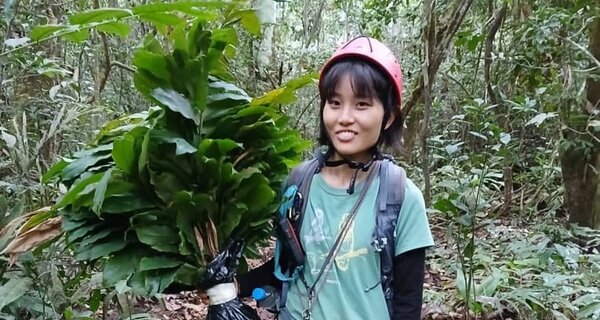
Banner image: Miku collecting African ginger during fieldwork in Moukalaba-Doudou National Park, Gabon (Photo by Pierre Philippe MBEHANG NGUEMA).
Here at Kyoto University Inuyama Campus, various labs stand next to each other. Today, I am interviewing Miku Minamikawa, who is a doctoral student in our ecology group. She is passionate about gorillas and has an interesting academic background. We talked about what made her interested in gorillas and her journey before and after entering the graduate school of Kyoto University.
What sparked your fascination with gorillas?
When I was in elementary school, I encountered a passage in a reading comprehension problem. The passage was taken from a book called Gorilla Zatsugaku Note(『ゴリラ 雑学ノート』)written by Juichi Yamagiwa. The story in that passage left a strong impression on me and became the starting point of my interest in gorillas. The passage introduced an episode in which a human child fell into a gorilla enclosure at an American zoo. An adult female gorilla carefully carried the human child and handed over to the zookeepers.
I was amazed to learn that there were animals other than pets or livestock that would help a human. Back then, news stories about environmental issues caused by humans were frequently reported. As a child, I vaguely thought that humans must be enemies of animals. However, the passage continued by describing how gorillas sometimes play with other animals such as birds and cats, and how even wild gorillas may allow humans to observe them.
Learning about these aspects of gorillas made me feel their gentleness. At the same time, it gave me an opportunity to start thinking about the possibility of coexistence between humans and other animals.
Before entering graduate school, what led you to pursue veterinary medicine? And what made you change the field of study for graduate school?
Originally, I hoped to enroll in Kyoto University, because it is well known for its research in primatology, but I was not accepted. I then thought, by studying diseases that infect gorillas such as Ebola virus disease, I might be able to contribute to gorilla conservation indirectly. With that in mind, I enrolled in the Faculty of Veterinary Medicine at Hokkaido University. However, once I entered veterinary school, I struggled to keep up and spent most of my student life feeling like I was falling behind.

Miku taking care of alpacas as a veterinary student (Photo by Nozomu Yamazaki).
For my undergraduate thesis, I conducted an epidemiological survey of infectious diseases transmitted by raccoons. In that sense, I was able to partially fulfill the goal I had when I first entered veterinary school. Although, at the same time, I also felt some frustration. In infectious disease research, animals often become merely subjects for sampling, rather than beings whose lives and behaviors are the focus of study. Through these experiences, I realized that what I truly wanted was to conduct research on the animals themselves. This realization ultimately led me to decide to pursue a graduate study.
There was another reason. When I was in my third year of university, I joined a tour to see Mountain Gorillas in Rwanda. During the tour, I was deeply excited to observe a group of gorillas that had been habituated to human presence. At the same time, I also felt a certain emptiness. I realized that simply visiting as a tourist meant that, aside from contributing to the local economy, I was not doing anything meaningful for the gorillas themselves.
This made me want to engage with gorillas not just through indirect contributions such as donations, but through research, observing them with my own eyes and trying to understand them scientifically. I also began to feel strongly that, if possible, I would like my work to contribute to local communities as well.

Mountain gorillas seen during the tour in Rwanda.
How did you decide where and what to study in graduate school?
The decisive factor in choosing where to go for graduate school was my participation in the Yakushima Macaque Research Group (ヤクザル調査隊). When I was in my fifth year as an undergraduate, an acquaintance introduced me to this research group working on the island of Yakushima, and I joined the fieldwork. At that time, the entrance exams for graduate programs were approaching, and I was struggling to decide on a topic for my master’s research. During the fieldwork, I spoke with Hanya-san (her supervisor now), who told me about a project focusing on the gut microbiota of wild great apes. I decided to jump on that project.
Through this opportunity, I began studying gorillas from an ecological perspective. Looking back, I had long been interested in environmental issues, so a study focusing on the plasticity of gut microbiota, how it flexibly changes depending on available food resources in environments where such resources are limited, fit my interests very well.
I believe the Yakushima Macaque Research Group provides an excellent framework for beginners to get a first glimpse into the world of primatology. I am very grateful that I had the chance to encounter this opportunity.
You graduated from a veterinary school. That means you could have entered a doctoral program next. Why did you instead choose to start in a master’s program?
Since my undergraduate training was in veterinary medicine, I felt that my knowledge of primatology was still insufficient. I wanted to study primates from the basics while conducting research at the same time. I also wanted to spend as much time as possible focusing on research in graduate school while studying gorillas, so I did not hesitate to start in a master’s program rather than immediately entering a doctoral program.
When did you finally get to study gorillas directly?
My first opportunity to conduct research on gorillas took place during February and March of my first year in the master’s program. I spent about a month in Moukalaba-Doudou National Park in Gabon. There, I conducted research on the gut microbiota of western lowland gorillas and chimpanzees.
Moukalaba had long been my dream research site. Since 1999, Japanese and Gabonese researchers have been conducting field studies of wild great apes there. Before arriving there, I was so nervous that I lost my appetite for about a week. However, once I arrived at the site, I realized that the research station was much more solid and better-equipped than I had imagined. I was also grateful that a collaborative research system with Gabonese researchers had already been well established. The trackers who guided us through the forest and the presence of other researchers were also very reassuring. Working together with many people while conducting research made me appreciate the unique appeal of fieldwork.

Miku conducting experiments at the research station in Gabon (Photo by Pierre Philippe MBEHANG NGUEMA)
Were you able to see the gorillas?
Yes. The first time I saw gorillas in Gabon was an unforgettable moment. A silverback sat firmly like a statue, looking toward us, while behind him adult females and juveniles were moving around. I could truly feel the dignity of the gorilla. The gorillas in Moukalaba have been habituated to humans over about five years through the tremendous efforts of the researchers who worked there before me.
The forest in Moukalaba is very dense, and there were many times when we could not see the gorillas because of the thick vegetation. Even so, the senior researchers who traveled with me patiently observed them through small gaps in the bushes, demonstrating remarkable perseverance and dedication. Through this experience, I realized that the opportunity to study gorillas in Moukalaba exists thanks to the tremendous efforts of those who came before us, and it made me determined to work hard so that I could stand on the same level as them.

Western lowland gorillas in Moukalaba-Doudou National Park, Gabon.
Looking back on your first year as a doctoral student, how has your experiencde been compared to when you were a master's student?
After advancing to the doctoral program, I have increasingly struggled with the gap between my abilities and my ideals. Studying primatology while carrying out research simultaneously has been challenging, and I often feel how difficult it is to continue pursuing a dream. I want to remember why I took this path in the first place: because I enjoy observing gorillas and monkeys and want to learn from them. For this reason, my personal motto during my doctoral study has been to “enjoy doing research.”
It is a great motto. Could you tell me what kind of research you will enjoy doing in the next few years?
I plan to focus on the fact that the western lowland gorilla, despite being the largest living primate, is surprisingly skilled at climbing trees. My research will investigate the relationship between gorillas’ movements and factors such as tree diameter and height. Through this work, I would like to continue exploring the question: how do gorillas skillfully use their environment?
Lastly, what is your dream?
One of the great attractions of primatology is the romance of identifying individuals and groups and following them over many years. Because of that, I have a big dream: to follow the life of a single wild gorilla, from birth until the end of its life.
At times I lose confidence about whether I will be able to continue in academia. However, as long as I still find research enjoyable, I would like to keep pursuing it. Life in the doctoral program often comes with uncertainty and many concerns, but here in Inuyama Campus, I am fortunate to have supportive colleagues around me. For that, I feel grateful every day.