



The PrimateCast

Catch interviews from the world of primatology, wildlife science and beyond with The PrimateCast. Available here or on iTunes. Subscribe to our rss feed, add us on iTunes and follow us on social media at Facebook and Twitter @ThePrimateCast. View all Podcasts


Topics
- Announcements (55)
- Podcasts (92)
- Publications (28)
- Research (7)
Recent News


February 19th 2026

October 7th 2025
Monthly Archive
- March 2026 (2)
- February 2026 (1)
- October 2025 (1)
- November 2024 (2)
- March 2024 (1)
- February 2024 (1)
Follow Us


Research Spotlight: Fitri Suhaimi (master's student, WRC)
Article by Brenda de Groot
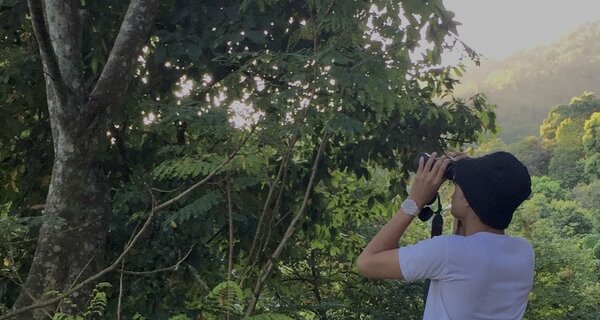
Banner image: Observing dusky langurs at coastal area of Teluk Bahang, Penang, Malaysia during Fitsu’s undergraduate Final Year Project.
At Kyoto University’s Wildlife Research Center (WRC), students come from across the globe to study primates in some of the world’s most biodiverse regions. Today, I’m speaking with Fitsu, a Master’s student whose academic journey began in Malaysia and led him to the rivers and mangroves of Sabah. We talk about how he found his way into primatology, what it is like to study proboscis monkeys in the field, and why studying primates in one’s home country matters.
Let’s go back to the beginning. Where did the primatology journey start for you?
I began my studies as a biology undergraduate at Universiti Sains Malaysia (USM). During my final year, I conducted my research project on dusky langurs on Penang Island. That was my first real exposure to primatology and fieldwork. I learned how to do behavioral observations, focal sampling, and other kinds of data collection. At that time, I wasn’t sure I wanted to continue on to a master’s program. After graduating, I decided to work instead. I became a veterinary assistant in Penang and worked there for over a year, also during COVID. Since veterinary work was considered frontline work, I was able to continue working outside of home even during lockdowns.
My work in the clinic was quite specific: it only treated cats. In Malaysia, many Muslim communities prefer not to handle dogs, so I served mostly Muslim clients who were more comfortable bringing their cats there. I learned a lot about animal care, but specifically about cats. After some time, I felt it wasn’t fulfilling enough for me intellectually. I realized I wanted something more, something that involved research and thinking more deeply, especially about primates.
So you wanted to shift from veterinary work back to doing primate research. How did the master’s program at Kyoto University enter the picture?
I saw an advertisement for the Ajinomoto Scholarship. It supports students from Southeast Asia to study science in Japan. I had taken Japanese as a minor during my undergraduate years, so it felt like fate somehow. I applied without very high expectations, especially because my proposal was about primates, and Ajinomoto is a food company. I wasn’t sure it would align with their interests. But I was selected!
The scholarship supports master’s studies and requires one year as a research student first. So I spent my first year in Inuyama, Japan, affiliated with the Center for Ecological Research (CER). During that time, I worked with Dr. Goro Hanya, who kindly hosted me. I worked on nutritional analysis of macaque food items. I blended plant-based stuff like bamboo shoots, leaves, and rice in the lab, which didn’t seem directly connected to my interests at first, but later became very useful when I began thinking about food nutrition in primates. Eventually, I officially joined Professor Matsuda’s lab at WRC for my master’s study, since I wanted to focus specifically on Malaysian primates, and he has a field site in Sabah.

Fitsu as a veterinary assistant before he started his Master’s.
What are you studying now for your master’s thesis?
My master’s research focuses on the long-term population monitoring of proboscis monkeys in the Lower Kinabatangan region of Sabah. Population surveys were conducted there in 2005 and again in 2014. My project continues that timeline, roughly every decade, to track changes in the population. I conduct boat-based surveys along the river. I stayed in the village doing some desk work in the morning, and then we would depart around 3:00 p.m. by boat and travel for about an hour until we find the monkeys. We then would begin counting and identifying groups as they gather near their sleeping sites before sunset. We return to the village after dark.
We also integrate GIS habitat data to analyze potential distribution ranges and examine how stable the population has been over time, especially in three long-term monitoring sites that have been surveyed almost monthly since 2005.
Some researchers are collecting fecal samples at the research site. In that case, your schedule looks different: you’d wake up at around 4:00 a.m. to go to the place where the monkeys went to sleep. They defecate early in the morning before entering the forest, so that is the best time to do fecal sampling work. So how your day in the field looks like depends on the type of data you are collecting.
You mentioned wanting to continue into a PhD program. What direction would you like to take next?
I’m very interested in multispecies coexistence, in other words, many different primates living together rather peacefully. In the Lower Kinabatangan, there are many species that coexist in the same forest patch. However, there are also differences in primate richness between locations. For example, pig-tailed macaques are only found in riverine forests, but not in mangrove areas. I want to understand why.
I’m particularly interested in two areas: nutrition and parasite prevalence. First, I want to compare plant nutritional content between mangrove and riverine habitats. If food quality differs significantly, that might explain why certain species are present in one habitat but not the other. Second, I’ve observed that in mangrove areas, monkeys—even highly arboreal proboscis monkeys—spend more time on the ground. That is interesting from a nutritional perspective, but might also increase exposure to soil-transmitted parasites. Higher ground use may correlate with higher parasite prevalence. By comparing nutrition, habitat use, and parasite exposure, I hope to better understand what shapes primate community composition.

Conducting boat-based proboscis monkey surveys in the riverine forests of Sabah, Borneo.
After spending so much time observing proboscis monkeys, is there anything about them that surprised you?
One surprising observation—though I’m not sure how appropriate it is to share—is that adult male proboscis monkeys frequently appear to have penile erections during observations. I wondered why. Perhaps it relates to their social system, since they live in one-male, multi-female groups. Maybe it has a signalling function? It is something that stood out during my field observations.
More generally, what surprises me is how specialized proboscis monkeys are. They have highly sensitive gastrointestinal systems, which makes them difficult to keep in captivity. That shows how closely adapted they are to their natural habitats.
That is a remarkable observation indeed! Those field surprises sometimes lead to interesting papers. Going back to your work, what ultimately motivates you to pursue your studies?
I would say, protecting the livelihoods of the primates is my main driver. If you visit Malaysia, you see how extensive the oil palm plantations are. And that impacts the primates and other animals who live there. I hope my research can contribute to more sustainable forest management, for example, that it could inform wildlife corridor design or habitat restoration. Not just for primates, but also for elephants, orangutans, sun bears, pangolins. Sabah has so much biodiversity.
I also believe strongly that researchers from primate range countries should study and become experts on their own wildlife. In Malaysia, many primatologists come from abroad. Collaboration with international researchers is important, but these primates are also our national treasure. We need local scientists to study and advocate for them. I want to contribute to that.
Last question: Do you have any advice for anyone who wants to become a primatologist?
I will answer this specifically for people in primate range countries. For example, in Malaysia, conservation jobs are not always seen as financially promising. People may question your choice. But if you are passionate, you should pursue it, because it’s your choice. Believe in yourself. Look for scholarships. There are opportunities. For me, it started with loving primates near my home. That passion carried me here.

Field course on Koshima, Japan—the first field course after arriving in Japan as a research student.